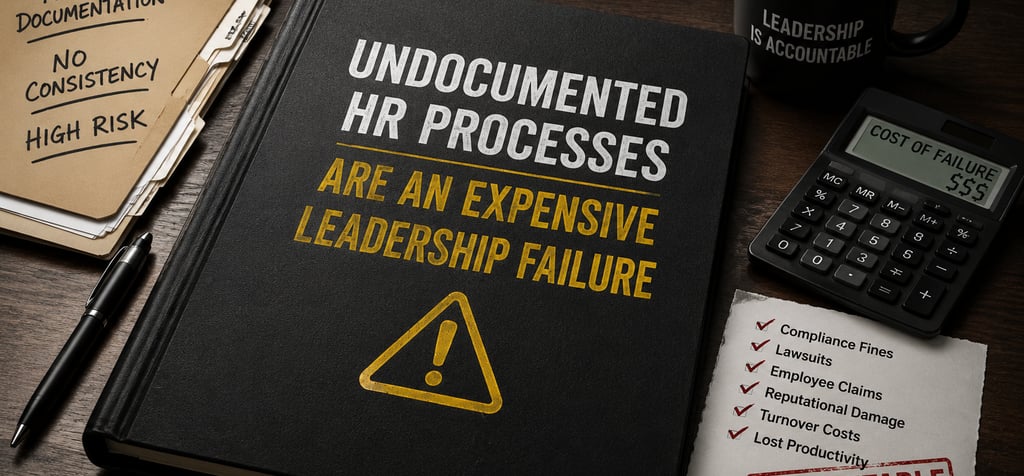
Undocumented HR Processes Are an Expensive Leadership Failure
One of the most overlooked threats to operational performance is not visible on an org chart or a balance sheet. It is the decision to let critical HR operations run without documentation, ownership, or control.
Far too many organizations still manage essential HR functions through verbal handoffs, outdated habits, fragmented email chains, and knowledge trapped in the heads of a few key employees. That may seem workable in calm periods.
But in moments that define leadership credibility, it becomes a costly liability:
Rapid growth
Leadership turnover
Employee complaints
Compliance audits
Workplace investigations
Terminations
Organizational restructuring
The moment consistency, fairness, or compliance is questioned, undocumented operations stop being a nuisance and start eroding trust, speed, and margin.
Most leadership teams do not realize how much institutional risk is sitting inside undocumented processes until an avoidable breakdown forces it into view.
A manager leaves.
An employee files a complaint.
Payroll is processed incorrectly.
A termination is mishandled.
A legal request is submitted.
A compliance agency asks for documentation.
That is when executives discover there is no reliable workflow, no operating standard, and no defensible record showing how decisions were made.
At that point, the organization is not leading operations; it is paying for preventable chaos and trying to rebuild control after the exposure has already occurred.
Documentation is not red tape.
It is executive infrastructure that protects the business, sharpens accountability, and preserves decision quality at scale.
When HR processes are properly documented, organizations gain:
Operational consistency
Reduced compliance exposure
Clear accountability
Faster onboarding
Better manager alignment
Easier cross-training
Stronger audit readiness
Without documentation, the business defaults to interpretation, and interpretation is a poor operating model.
Interpretation drives inconsistency.
Inconsistency drives cost.
For example:
If two managers respond to the same employee issue in different ways because no documented procedure exists, the organization not only creates confusion but also exposes itself to claims of favoritism, discrimination, and unfair treatment.
At that stage, the issue is no longer just a difference in management style. It becomes a preventable compliance and legal problem that leadership now has to fund, defend, and explain.
This matters even more in HR because employment decisions directly affect:
Wage and hour compliance
Employee classification
Leave administration
Corrective action
Workplace investigations
Documentation retention
Termination procedures
If these areas are not standardized and documented, risk does not remain contained. It compounds quietly, drains resources, and eventually surfaces as a far more expensive problem than it ever needed to be. Many organizations mistakenly assume documentation means producing a large employee handbook. It does not.
Effective operational documentation includes:
SOPs
Workflow maps
Approval structures
Escalation procedures
Compliance calendars
Role accountability definitions
Investigation protocols
Decision authority structures
The objective is not excessive paperwork.
The objective is operational clarity, consistent execution, and control that can withstand growth, scrutiny, and change.
High-performing organizations do not build around tribal knowledge.
They invest in systems that maintain consistent performance, protect leadership decisions, and support growth without operational drift.
That is what scalable leadership looks like.
No business can scale responsibly when critical operational knowledge exists only in conversations, inboxes, or individual memory.
Documentation is what turns reactive HR administration into a disciplined operating advantage
One final takeaway:
If your organization cannot clearly document how critical HR decisions are made, you do not have a documentation issue. You have a leadership, risk, and execution problem that will only become more expensive with time.
info@elevarehrsystems.com
9803 HWY 242 Conroe, TX 77385
A 100% digital, asynchronous HR consulting firm.
AI-assisted platform. Informational use only. Not legal or employment law advice.
AI-assisted communication platform. Informational use only. Not legal or employment law advice. Official HR guidance is provided through formal client engagements